Every growing business has the same invisible bottleneck: scattered customer data. Your sales team uses one spreadsheet, your support team has another inbox, and your marketing team is working off a third list — none of them is talking to each other. By the time a deal closes or a complaint needs to be resolved, someone is already digging through old emails.
This is exactly the problem a CRM portal solves. And in 2025, building a custom CRM portal tailored to your specific business workflows has become one of the smartest technology investments a growing company can make.
In this guide, we break down what a CRM portal actually is, what it does for your business, and a step-by-step look at how to build one — from planning to launch.
What Is a CRM Portal?
A CRM portal (Customer Relationship Management portal) is a centralised, web-based platform that brings together your customer data, communication history, sales pipeline, support tickets, and team workflows — all accessible from a single secure interface.
Unlike a basic CRM tool, a portal adds a client-facing layer: your customers can log in, view their order status, raise support tickets, download invoices, and communicate with your team — all without sending a single email.
5 Reasons Your Business Needs a CRM Portal Now
Single Source of Truth
All customer data — contacts, history, deals, tickets — lives in one place. No more version conflicts between teams.
Faster Sales Cycles
Automated follow-ups, pipeline tracking, and lead scoring reduce the time from prospect to close significantly.
Self-Service for Clients
Clients check order status, raise tickets, and download invoices without calling your team — freeing up support hours.
Data-Driven Decisions
Built-in analytics reveal churn risk, sales performance, and customer behaviour patterns in real time.
Seamless Integrations
Connect your CRM portal to billing, ERP, WhatsApp, email, or any third-party tool your business already uses.
Scales With You
Unlike off-the-shelf tools, a custom portal grows with your business — new modules, users, and workflows on demand.
Research consistently shows the impact: over 90% of companies with more than 10 employees use some form of CRM solution — yet most outgrow generic tools within two to three years of scaling. A custom CRM portal development project is often the natural next step for businesses that have hit the ceiling of SaaS platforms.
Wondering if your current setup has crossed that threshold? Our post on Top 7 Signs Your Business Needs a Custom CRM System
Custom CRM Portal vs Generic SaaS CRM: What's the Real Difference?
Tools like Zoho, Salesforce, and HubSpot are powerful — but they're built for a broad market. When your business has non-standard workflows, complex approval chains, or niche industry requirements, you constantly find yourself working around the tool rather than with it.
A custom CRM portal built by a dedicated web portal development company like CodeGenie is designed around your actual processes — your field names, your pipeline stages, your customer hierarchy, your reporting metrics. Every screen, every workflow, every integration is built to fit exactly how your team operates.
Key Features of a Well-Built CRM Portal
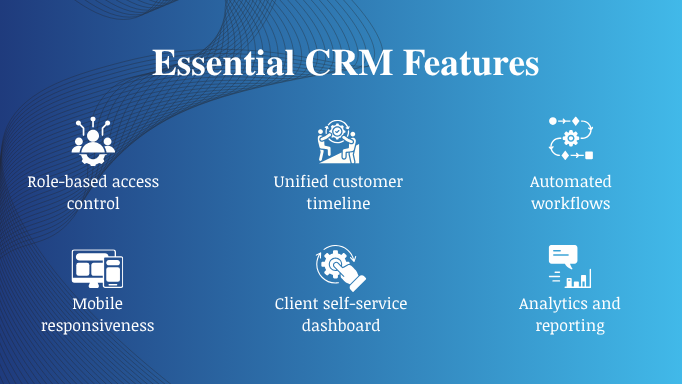
Not all CRM portals are created equal. Here's what a robust custom portal development project should include:
-
Role-based access control — different views for sales reps, managers, clients, and admins
-
Unified customer timeline — every call, email, deal, and ticket in one scrollable history
-
Automated workflows — follow-up reminders, escalation triggers, and approval chains
-
Client self-service dashboard — order tracking, document downloads, and ticket submission
-
Analytics and reporting — revenue forecasting, churn risk, team performance dashboards
-
Third-party integrations — WhatsApp API, email, billing systems, ERP, logistics platforms
-
Mobile responsiveness — full functionality on any device, especially field sales teams
Every feature you add to a CRM portal should serve a clear business purpose. Our guide to Must-Have Features for a Successful Business
How to Build a Custom CRM Portal: Step-by-Step
Here's how a structured CRM portal development project works — from idea to a live, working system.
Discovery & Requirements Mapping
Document your exact workflows — how leads are captured, how support tickets flow, what reports management needs. This phase defines every feature and integration before a single line of code is written.
UI/UX Design & Prototyping
Wireframes and clickable prototypes are built for every major screen. Your team reviews and approves the UX before development begins — saving costly revisions later.
Backend & Database Architecture
Engineers design a scalable database schema and API layer. For CRM portals, this typically uses Node.js or PHP backends with MySQL/PostgreSQL databases, built to handle 100,000+ records without slowdown.
Frontend Development
The portal interface is built — responsive, fast-loading, and intuitive. React or Vue.js are common choices for dynamic portals with real-time data updates.
Integration & API Connections
Connect the portal to your existing tools — payment gateways, email platforms, WhatsApp Business API, ERP systems, or any third-party service your team relies on.
Testing & Quality Assurance
Functional, performance, and security testing across all devices and browsers. Data encryption, access controls, and role permissions are verified at this stage.
Deployment, Training & Support
The portal is deployed on a secure cloud server. Your team receives onboarding training, and post-launch support is provided for ongoing improvements and maintenance.
How Much Does CRM Portal Development Cost in India?
India is among the most cost-competitive markets globally for custom portal development. A mid-complexity CRM portal — with client-facing dashboards, role-based access, automated workflows, and integrations — typically falls in the range of ₹4 lakh to ₹18 lakh, depending on feature depth and integration complexity.
This is a fraction of the equivalent cost with a US or European development agency — while using the same technology stack and engineering standards. Working with a dedicated software development company in Delhi like Codegenie gives you a full project team: business analyst, UI/UX designer, backend and frontend developers, and a QA engineer.
For a deeper breakdown of what drives CRM development costs — modules, team size, timelines, and what's worth budgeting for — read our dedicated guide: CRM Development for Business: Feature & Cost Guide
Why Choose Codegenie for Your CRM Portal?
CodeGenie has been delivering custom portal development projects since 2017 — from simple client dashboards to complex multi-tier CRM platforms used by businesses across India and internationally. Our approach is straightforward: we start with your business process, not a template.
Every portal we build includes a discovery phase where we map your exact workflows, data relationships, and user roles before writing code. The result is a system your team actually wants to use — not one they're forced to adapt to.
Still confused about what's right for your business? Custom portal, off-the-shelf CRM, or something in between — our team at Codegenie will help you figure it out. No jargon, no pressure. Just a clear conversation about what your business actually needs. Contact CodeGenie to Clear Your Confusion.