PWA vs Native App: Which Is Right for Your Business in 2026?
PWA vs Native App — which one should you build in 2026? Simple comparison of cost, performance, and use cases to help you make the right decision.
Mobile App Development
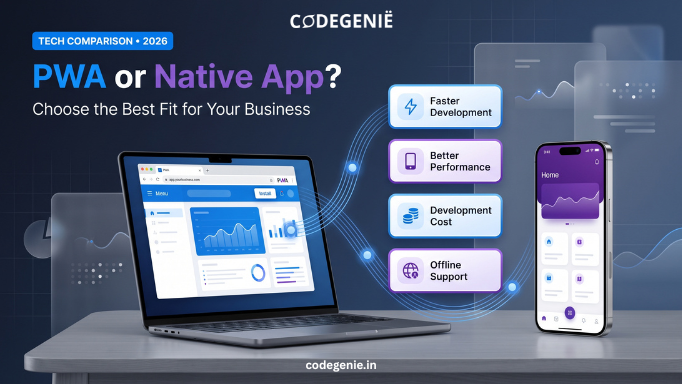
When a business decides to go mobile, the first real decision is this: Do you build a Native App or a Progressive Web App (PWA)?
Both give your users a mobile experience. Both have real advantages. But they work very differently, cost very differently, and suit very different types of businesses.
Here's a simple breakdown to help you decide.
What Is a Native App?
A Native App is built specifically for one platform — iOS or Android. It is downloaded from the App Store or Google Play and lives on the user's phone.
Apps like Instagram, Zomato, and Uber are native apps. They use the phone's full capabilities — camera, GPS, push notifications, fingerprint scanner — and feel completely natural with the device.
Built with: Swift / Kotlin (or React Native / Flutter for cross-platform)
What Is a PWA?
A Progressive Web App is essentially a website that behaves like an app. Users open it in a browser, but it feels and works like a mobile app — it loads fast, works offline, and can even be added to the home screen.
Twitter Lite, Pinterest, and Starbucks all use PWAs. They don't require an App Store download and work on any device with a browser.
Built with: HTML, CSS, JavaScript (any modern web framework)
PWA vs Native App — Side by Side
| Feature | PWA | Native App |
| App Store Required | ❌ No | ✅ Yes |
| Works Offline | ✅ Limited | ✅ Full |
| Push Notifications | ✅ Yes | ✅ Yes |
| Access to Phone Hardware | ⚠️ Limited | ✅ Full |
| Development Cost | Lower | Higher |
| Maintenance | Easier | More complex |
| Performance | Good | Best |
| Discoverability | Via Google Search | Via App Store |
Cost Comparison
This is where the difference becomes very clear.
PWA Development Cost: ₹50,000 – ₹2,00,000
One codebase works for all devices — mobile, tablet, and desktop. No separate iOS and Android versions needed.
Native App Development Cost: ₹1,50,000 – ₹8,00,000+
You either build two separate apps (iOS + Android) or use a cross-platform framework. Either way, it costs more than a PWA.
If budget is a constraint and you need to launch fast, a PWA gives you the most value for money.
Performance — Who Wins?
Native apps are faster and smoother — especially for complex animations, real-time features, and heavy graphics. They have direct access to the phone's processor and memory.
PWAs have improved a lot in 2026 and perform excellently for most standard use cases — browsing, ordering, reading, booking. But for apps that need camera-heavy features, AR, or high-end gaming, native is still ahead.
When Should You Choose a PWA?
- You need to launch quickly on a limited budget
- Your audience is primarily mobile web users
- Your app is content-heavy — news, blogs, ecommerce, food ordering
- You want users to access it without downloading anything
- SEO and Google discoverability matter to your business
Real example: An ecommerce brand that wants a fast, app-like shopping experience without asking users to download an app — PWA is perfect.
When Should You Choose a Native App?
- Your app needs full access to phone hardware — camera, GPS, Bluetooth, sensors
- You need complex animations or real-time features like live tracking
- You're building a fintech, healthcare, or gaming app
- User retention and engagement are top priorities
- You want to be listed on the App Store or Google Play
Real example: A food delivery startup with live order tracking, driver GPS, and push notification campaigns — native app is the right call.
Can You Have Both?
Yes — and many businesses do exactly this.
Start with a PWA to launch fast and validate the idea. Once you have real users and real feedback, invest in a native app with the features your users actually need. This approach saves money early and reduces the risk of building the wrong thing.
Frequently Asked Questions
Is a PWA better than a native app?
Not better — different. PWAs are faster to build and cheaper to maintain. Native apps offer better performance and hardware access. The right choice depends on your use case.
Can a PWA work without internet?
Yes, to a limited extent. PWAs use service workers to cache content and work offline — but not as fully as a native app.
Do PWAs show up on the App Store?
No. PWAs are accessed via browser or added to the home screen directly. They don't appear on the App Store or Google Play.
Which is better for ecommerce — PWA or native app?
PWA is often the better starting point for ecommerce. It's faster to build, works across all devices, and is discoverable via Google Search. Many large ecommerce brands use PWA as their primary mobile experience.
How long does it take to build a PWA vs a native app?
A PWA typically takes 4–8 weeks. A native app takes 3–6 months, depending on features and platforms.
Final Verdict
There's no universal winner between PWA and native apps. The right choice comes down to three questions:
1. What does your app need to do? — Simple content or complex hardware features?
2. What's your budget? — PWA costs significantly less upfront
3. How fast do you need to launch? — PWA wins on speed every time
When in doubt, start with a PWA. Build native when your business is ready for it.
At CodeGenie, we build both PWAs and native apps — depending on what your business actually needs. Not sure which direction to go? Let's figure it out together.
[Get a Free Consultation → (https://www.codegenie.in/contact)