How Much Does Custom Software Development Cost in 2026?
Uncover custom software development costs, reliable pricing estimates, and core financial drivers to launch your new digital product completely stress-free.
Web Applications Development

One important question businesses face when planning a new digital product is how much it will cost. Since custom software is built from scratch to solve the operational challenges of a business, there is no standard price tag for custom software.
In this guide, we will explore the cost factors of custom software development, the key elements that shape the budget, project timelines and smart ways to launch a product successfully on time and within budget.
What is Custom Software Development?
Custom software development involves designing, building, and deploying applications tailored specifically for a set of users, functions, or organisations.
Unlike off-the-shelf software, custom solutions give businesses ownership. This allows them to create systems that fit their workflows, scale easily and provide a real advantage over competitors.
Common Examples of Custom Software:
Scalable SaaS Platforms: Multi-tenant software applications designed for use.
Web & Mobile Applications: Customer-facing. Native or cross-platform mobile experiences.
API Integrations: Custom middleware that connects legacy databases to cloud systems.
ERP & CRM Systems: Centralised dashboards tailored to business operations.
Business Automation Tools: Workflows that reduce data entry and human error.
Global Custom Software Development Cost Estimates
The investment needed for custom software depends on the project's scope, feature complexity and system architecture.
| Software Tier Project Description | Average Cost Range | |
| Startup MVP | Minimum Viable Product with core features to test market fit and clean UI/UX. | $20,000 - $40,000 |
| Medium Complexity Platform | Fully integrated business tools, advanced SaaS web apps or custom mobile applications. | $45,000 - $100,000 |
| Enterprise Software | Secure scalable systems with extensive automation, deep data pipelines or AI integrations. | $100,000 - $250,000+ |
Key Factors Driving Software Development Costs
Understanding the main cost influencers helps businesses make smart decisions and avoid unexpected budget increases.
1. Feature Complexity & Scope
The number of screens, user roles and the nature of the features directly affect coding hours. Basic elements like user authentication or simple dashboards are straightforward, while advanced features require skills:
Standard Features: Email signups, basic reporting, profile management and CRUD operations.
Advanced Features: Real-time data streaming, AI/Machine Learning algorithms, predictive analytics and automated workflows.
2. Technology Stack Selection
The underlying technologies affect not only initial development speed but also long-term scaling and hosting costs. Choosing the tech stack ensures good performance and strong security.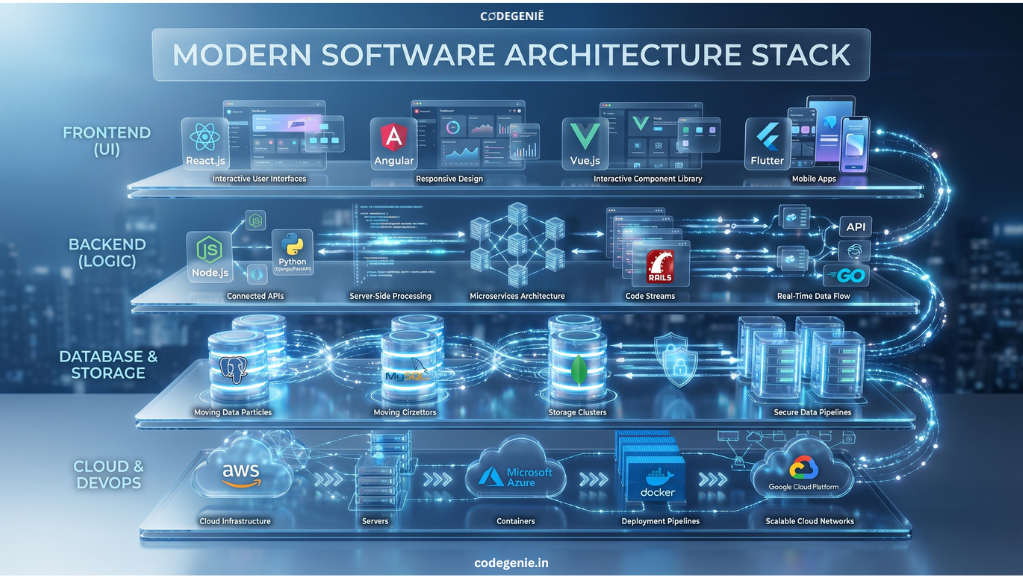
3. Engineering Team Structure
The size and skill level of the development team relate to the project's scale. A rounded, effective team typically includes:
Project Manager / Scrum Master: To keep the project on track.
UI/UX Designers: To create user journeys, wireframes and interactive prototypes.
Frontend & Backend Engineers: To write maintainable code.
QA Testers: To conduct automated and manual bug testing.
4. Third-Party API Integrations
If an application needs to connect with systems, custom API integrations will be necessary. Integrating tools like payment gateways, communication APIs, enterprise CRMs or logistics trackers adds complexity. Enables significant automation.
5. High-Fidelity UI/UX Design
Great software must be easy to use. Investing in custom user experiences—complete with data visualisations, sleek dashboards and responsive layouts across mobile and web—requires substantial prototyping and user testing. This can raise costs.
Typical Custom Software Development Timelines
A structured development life cycle ensures software is delivered efficiently without compromising quality.
Basic MVP App: 2 - 3 Months
Commercially Ready Business Platform: 4 - 6 Months
Enterprise-Grade Scalable Infrastructure: 6 -12+ Months
The Reality of Post-Launch Maintenance
Launching the software is the beginning. To keep a product secure, fast, and compatible with ongoing browser and OS updates, businesses should budget roughly 15% to 20% of the initial development cost annually for DevOps, hosting, security updates, and minor feature enhancements.
Actionable Tips to Optimise Your Development Budget
Businesses do not need to cut features to save money. Instead, they should focus on planning:
1. Launch a Minimum Viable Product (MVP) First: Build the core value proposition first. Get user feedback before heavily investing in extra features.
2. Lock Down Clear Requirements Early: Changing the project scope during development is the cause of budget overruns. Spend time planning wireframes before coding starts.
3. Choose Cross-Platform Frameworks: If developing for both iOS and Android using frameworks like Flutter or React Native allows sharing a codebase, it lowers mobile development costs by up to 40%.
4. Partner with an Experienced Development Agency: Freelancers can be unpredictable. Building an in-house team can be costly. Outsourcing to a trusted agency provides expertise that keeps the project moving efficiently.
When is the Right Time to Invest in Custom Software?
Off-the-shelf software works well for tasks, but businesses should switch to a custom build when:
Their current subscription tools can't support their business processes.
They waste hours moving data manually between unintegrated software platforms.
They want to create a SaaS product to leverage their industry knowledge.
Their operations require data security, compliance and complete data ownership.
Build the digital product stress-free with CodeGenie. Understanding the costs of custom software development does not have to be complicated. If a business needs a partner to bring its vision to life without hidden fees or surprising budget changes, CodeGenie is here to assist.
With over 9 years of industry experience, CodeGenie specialises in creating high-performance SaaS platforms UI/UX design, mobile and web applications and complex API integrations. CodeGenie promises to deliver custom software on time and within budget.
Ready to get a financial breakdown for the project? Get a quote from CodeGenie today.