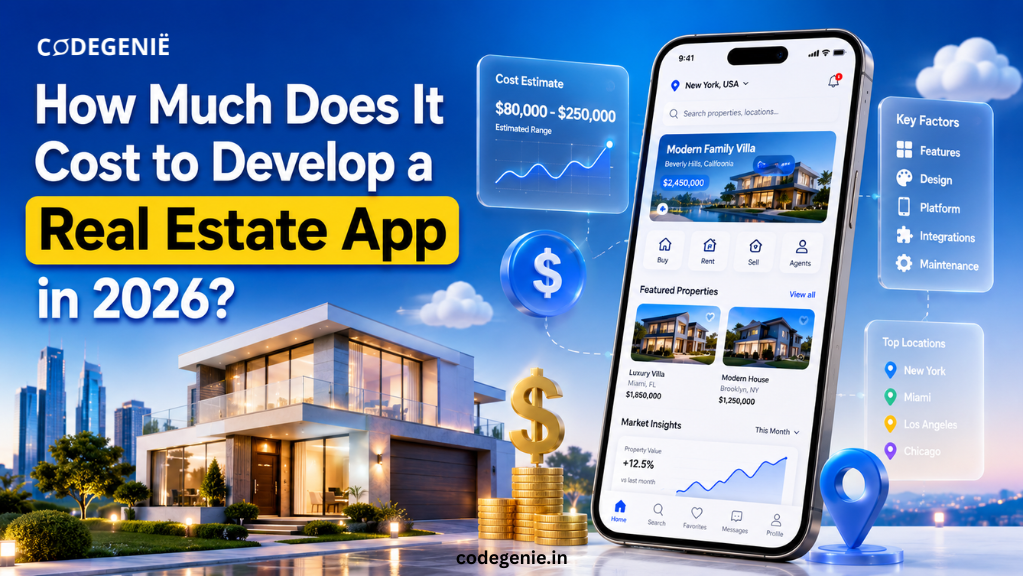
The property market is changing quickly. Today, buyers, renters, and agents depend heavily on mobile apps to search for properties, schedule virtual tours, and complete transactions. If you're a business aiming to meet this increasing demand, you may be wondering: what’s the real cost to develop a real estate app in 2026?
The reality is that there is no one-size-fits-all answer. The cost varies based on features, technology choices, and the complexity of your idea. In this guide, we’ll cover the essential features, factors that affect your budget, and practical ways to reduce costs before you start. This will help ensure your product is delivered on time and within budget.
1. Key Features that Impact the Cost to Develop a Real Estate App
Every feature you add improves user experience but also increases the investment required. Let’s explore the essentials: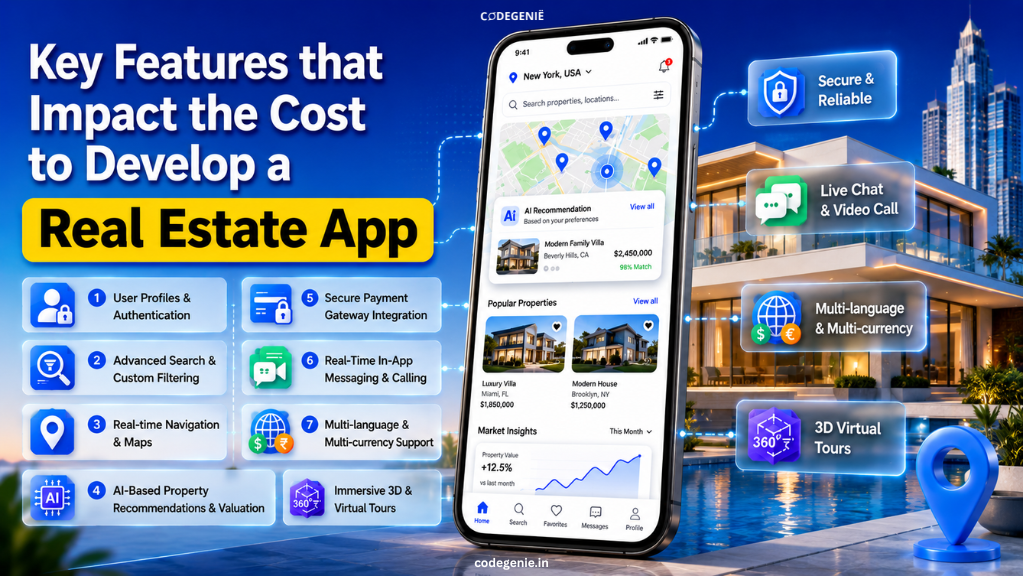
1.1 User Profiles & Authentication
- Allows users to sign up or log in securely using options like Google, Facebook, Apple ID, or traditional email and phone numbers.
- A well-structured profile system distinguishes roles for Buyers/Renters (to manage saved properties) and Real Estate Agents (to manage property listings and leads).
- This feature provides convenience and improves personalization based on the user’s search history.
1.2 Advanced Search & Custom Filtering
- Includes a strong catalog that lets users sort properties by physical features, price per square foot, school districts, or specific transit options.
- Offers quick comparison tools to assist users in evaluating multiple properties side-by-side.
- Ensures real-time database responsiveness so users always see accurate information.
1.3 Real-time Navigation & Maps
- Uses GPS for live tracking, location-based suggestions, and neighborhood boundary visualization.
- Integrating with mapping services like Google Maps or Mapbox APIs allows for route planning and discovering local attractions, schools, and grocery stores.
- Heatmap features are especially useful for investors analyzing regional market data and growth patterns.
1.4 AI-Based Property Recommendations & Valuation
- Uses machine learning to understand user behavior and preferences, suggesting tailored property listings and investment opportunities.
- Automates dynamic valuation alerts, price-drop notifications, and package suggestions based on budget and market history.
- Powers automated valuation models (AVM)—similar to premium estimation engines—for calculating immediate market value.
1.5 Secure Payment Gateway Integration
- Provides a secure payment process that supports various options, including credit/debit cards, digital wallets, and UPI.
- Facilitates smooth transactions for application listing fees, premium agent subscriptions, or secure handling of security deposits.
- Ensures transaction encryption and strict fraud detection measures to protect sensitive financial information.
1.6 Real-Time In-App Messaging & Calling
- Enables secure, instant chat and video links to connect active buyers directly with listing agents.
- Includes immediate push notifications and document sharing features for fast lease or contract processing.
- Boosts user engagement and quickens the property closing process.
1.7 Multi-language & Multi-currency Support
- Supports localization for international buyers by adapting to their language and currency needs.
- Improves user experience and builds trust, increasing the app’s global appeal and accessibility.
- Important for cross-border real estate transactions and high-end luxury property markets.
1.8 Immersive 3D & Virtual Tours
- Incorporates interactive media elements (like Matterport or 3D view embeds) into property listings.
- Allows remote users to take virtual tours of properties from anywhere in the world.
- Promotes transparency, filters out unqualified leads, and saves valuable time for real estate agents.
2. Factors that Influence Real Estate App Development Costs
Many factors impact the cost to develop a real estate app:
2.1 App Type & Complexity
- Basic Real Estate App: Offers minimal functionality, like simple search and static property listings; suited for small local brokerages.
- Mid-range App: Features moderate elements like AI-driven suggestions, advanced filters, live MLS synchronization, and multiple user roles.
- Enterprise-level App: Represents full-scale property marketplaces with advanced features such as predictive market analytics, immersive 3D virtual tours, and extensive custom CRM integrations.
2.2 Platform Choice
- Native Development: Creating separate apps for Android (Kotlin) and iOS (Swift) leads to better performance but doubles the cost and time.
- Cross-platform Development: Using a single codebase for both platforms with modern frameworks like Flutter or React Native can save 30% to 40% of the budget.
2.3 UI/UX Design Complexity
- A visually appealing and user-friendly interface often needs custom animations, interactive transitions, and high-quality design elements.
- Higher complexity in creating custom UI/UX design wireframes and interactive prototypes results in increased development time and cost.
2.4 Backend Development & API Integrations
- A solid backend engine ensures a smooth and secure data flow between the server database and the mobile front-end.
- Integrating with complex third-party real estate data sources (like regional MLS via RESO Web API) increases technical complexity.
2.5 Security & Compliance
- Real estate apps manage sensitive personal data, financial records, and legal documents.
- Implementing features like two-factor authentication (2FA), data encryption, and compliance with regulations like GDPR or PCI DSS is crucial for user trust.
2.6 Technology Stack
- The choice of programming languages and cloud tools directly affects development time, performance, and long-term scalability.
- For example, using Node.js for real-time chat capability, PostgreSQL for relational data, and AWS or Google Cloud for scalable infrastructure.
2.7 App Maintenance & Updates
- Regular updates to fix bugs, optimize cloud servers, and ensure compatibility with the latest iOS and Android versions are essential.
- Ongoing technical maintenance typically consumes 15-20% of the original development budget each year.
3. Estimated Cost Breakdown in 2026
The cost of developing a real estate app varies based on complexity, technology choices, and features. Below is an estimated cost breakdown:
| App Type | Estimated Cost (USD) | Development Time |
| Basic Real Estate App (MVP) | $25,000 – $65,000 | 2 - 3.5 months |
| Mid-level Business App | $65,000 – $140,000 | 4 - 8 months |
| Enterprise Platform | $140,000 – $250,000+ | 8 - 18+ months |
4. Hidden Costs to Consider
Beyond initial software development, several extra expenses can arise during product deployment:
4.1 Third-Party API Costs
- Access to live property databases via MLS APIs usually involves usage-based data access fees.
- Mapping services like Google Maps or Mapbox can also become costly as your active user base grows.
4.2 App Store & Play Store Fees
- To publish your app, you need to pay developer platform fees: Google Play charges a one-time $25 fee, while the Apple App Store charges an annual $99 fee.
4.3 Marketing & ASO (App Store Optimization)
- Drawing in organic downloads requires a dedicated marketing budget for paid digital campaigns and App Store Optimization (ASO) strategies.
- High-ranking industry keywords, attractive store visuals, and optimized metadata are key to increasing your app's visibility.
4.4 Ongoing Maintenance & Support
- Regular bug fixes, API compatibility checks, server management, and customer support will lead to ongoing costs.
- This is estimated at around 15-20% of the initial development cost annually.
5. Smart Ways to Optimize Real Estate App Development Costs
Here are some effective strategies to lower development costs without sacrificing quality:
5.1 Choose Cross-platform Development
- Utilizing tools like Flutter or React Native allows you to build one app that works well on both Android and iOS, significantly reducing engineering effort.
5.2 Start with an MVP (Minimum Viable Product)
- Launching a simple version of your app with just the core features (like basic listings and search maps) helps validate your idea and gather user feedback before making a larger investment.
5.3 Use Ready-made APIs Instead of Custom Engines
- Employing existing APIs for payment gateways (like Stripe), messaging (like Twilio), and map features saves substantial custom development time.
5.4 Outsource Development to Cost-effective Regions
- Working with experienced software development agencies in tech hubs like India or Eastern Europe allows you to access top talent at competitive rates.
6. Is It Worth the Investment?
- Yes, if done right. The cost to develop a real estate app in 2026 may seem high at first, but the return on investment can be much greater in today's thriving PropTech market. By focusing on seamless user experiences, reliable backend data synchronization, and launching a well-designed product, you can set your real estate business up for significant global growth.
Need Expert Assistance?
At CodeGenie, we specialize in custom software development with over 9 years of industry experience. We focus on SaaS development, quality UI/UX design, web applications, API integration, and digital marketing. Our goal is to deliver your custom application on time and within budget.
Ready to launch your Real Estate app? Get in touch with us now!