AI Chatbot Integration in Mobile Apps: Complete Guide 2026
Learn how AI chatbot integration works in mobile apps in 2026 — types, tools, architecture, cost, and best practices. A complete guide for businesses.
General
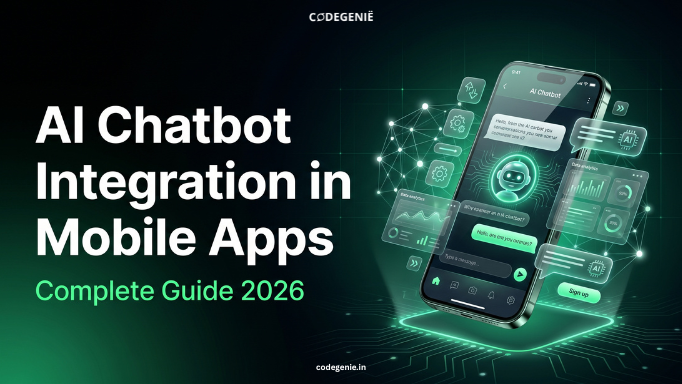
In 2026, users expect instant answers the moment they open an app. Waiting for a support email or calling a helpline feels outdated. This shift in expectations is exactly why AI chatbots have moved from a "nice-to-have" feature to a core part of mobile app strategy.
If you are planning to add a chatbot to your app, this guide covers everything — what kind of chatbot you need, how integration actually works, what it costs, and the mistakes most businesses make along the way.
Why AI Chatbots Matter in 2026
Mobile apps that respond instantly retain users. Apps that make people wait lose them — often after a single bad experience. An AI chatbot solves this by handling common questions, processing simple tasks, and escalating to a human only when truly needed.
Beyond user experience, chatbots reduce support costs significantly since one bot can handle thousands of conversations simultaneously without additional staff.
Integration Approaches — Which One Fits Your App?
There is no single "best" way to integrate a chatbot. The right approach depends on your timeline, budget, and how much control you need.
1. SDK-Based Platforms (Fastest)
Platforms like Kommunicate, Dialogflow, or ProProfs provide a ready-made chat UI, AI-to-human handoff, and bot integrations with providers like OpenAI or Gemini already built in.
This approach provides a built-in UI, handles AI-to-human handoff, and requires no custom backend — though it offers less granular control over the underlying architecture compared to building from scratch. It is best suited for MVPs and apps that need support capability fast.
2. Direct LLM API Integration
This approach connects your app directly, through a middle tier, to providers like OpenAI, Anthropic, or Gemini. It gives you more flexibility in tone, behaviour, and use case, but requires backend development to manage securely.
3. Custom Backend with Full Agent Orchestration
This option supports full multi-agent orchestration with tool usage and long-term memory, along with custom vector store integration using tools like Pinecone, Weaviate, or pgvector. It comes with very high engineering cost and long build timelines and is best suited for serious AI infrastructure where differentiation is the primary business goal.
Types of Chatbots — Know the Difference First
Before integrating anything, it's important to understand what kind of chatbot your app actually needs.
Rule-Based Chatbot
Works like a flowchart. If a user types or selects something outside the predefined script, it fails. Common in basic FAQ bots with fixed buttons.
AI Chatbot
Uses Natural Language Processing (NLP) and machine learning to understand what users mean, not just what they type. It improves over time as it processes more conversations.
Conversational AI
The most advanced layer. It handles multi-turn conversations, remembers context across the chat, and can perform real actions — like booking a slot or processing a payment — not just answering questions.
In 2026, there are three primary architectural approaches for building a chatbot — using LLM APIs directly from providers like OpenAI, Anthropic, or Gemini, building a custom backend with full agent orchestration and memory, or using a ready-made SDK platform.
Core Features Every Chatbot Needs
A production-ready chatbot in 2026 needs context memory so users don't have to repeat themselves, human handoff to escalate issues a bot can't resolve, voice support for hands-free interaction, an analytics dashboard to track drop-off points and resolution rates, multi-language support for international users, and secure API calls to protect data during every exchange.
Skipping any of these features early on usually means rebuilding the chatbot later — so it's worth planning for all six from day one.
How the Architecture Works (Simplified)
A chatbot inside a mobile app is never directly connected to an AI provider. There is always a middle layer in between, and for good reason.
Mobile App (Frontend)
↓
Backend / Middleware
↓
AI Provider (OpenAI / Anthropic / Gemini)
API keys should never be exposed in client-side code, and all data should be encrypted both at rest and in transit. This middle layer handles authentication, rate limiting, and logging — and keeps your AI provider's API key completely hidden from the app itself, a basic but critical security requirement.
Security — Non-Negotiable in 2026
Chatbots handle real conversations, often with personal or sensitive data. Every endpoint should use HTTPS, sensitive tokens should be stored using encrypted storage, and every message should be logged for compliance and analytics. API gateway controls should monitor usage and enforce policies.
Since chatbots can generate thousands of interactions daily, the backend should handle traffic spikes using queues like RabbitMQ or Kafka, so performance doesn't degrade under load.
Cost of Building an AI Chatbot in 2026
Cost depends heavily on complexity. A simple FAQ-style chatbot will cost far less than one that handles bookings, payments, and multi-language support.
| Chatbot Type | Estimated Cost | Timeline |
| Basic FAQ Chatbot | Lower-budget, simple integration | 3–4 weeks |
| Personalised Chatbot (multiple integrations) | Mid-range investment | 6–8 weeks |
| Advanced AI Chatbot (GPT-powered, RAG, multi-language) | $50,000 – $200,000+ | Several months |
A basic chatbot that handles common questions typically takes 3 to 4 weeks to build and test, while more complex chatbots with personalisation and multiple integrations require 6 to 8 weeks, depending on the availability of training data.
For smaller businesses, cloud-based chatbot solutions are also accessible, with monthly costs starting from around ₹15,000–₹30,000 depending on usage — support cost savings usually cover the chatbot's expenses within 3 to 4 months.
What Happens When the Chatbot Can't Answer?
This is one of the most overlooked parts of chatbot design. A good chatbot should recognise when it doesn't know an answer and immediately offer to connect the user with human support — it should never make up answers or frustrate users with incorrect information. Having a clear escalation path is essential.
Apps that skip this step often see chatbot adoption drop quickly, because users lose trust the moment a bot gives a confidently wrong answer.
Where AI Chatbots Are Heading Next
The chatbot landscape is moving toward agentic AI — bots that don't just answer questions but take real actions autonomously, like booking appointments or processing refunds. Voice-first interactions are also growing as voice interfaces mature, and emotion-aware bots are starting to adapt their tone based on how a user feels.
Design with these capabilities in mind early — retrofitting agentic actions into a basic Q&A bot later is far more expensive than planning for them up front.
Final Thoughts
AI chatbot integration in 2026 isn't just a support feature — it's becoming core infrastructure for any mobile app that serves customers. The technology has matured enough that getting started is no longer the hard part. The real work lies in choosing the right architecture, securing the integration properly, and designing clear escalation paths so users always get a good experience, bot or human.
Start with a clear use case, pick the integration approach that matches your budget and timeline, and build security in from day one — not as an afterthought.
Need Help Building Your Chatbot?
At CodeGenie, we help businesses design and integrate AI chatbots that actually solve real problems — from simple FAQ bots to advanced conversational AI with booking and payment capabilities. We handle the architecture, security, and integration so you can focus on your product.
Get a Free Consultation → https://www.codegenie.in/contact