How Much Does It Cost to Build a Healthcare App in 2026?
Wondering what a healthcare app costs in 2026? Here's a real breakdown of pricing, HIPAA costs, and what actually drives the budget up or down.
Mobile App Development
If you've started asking around about building a healthcare app, you've probably already noticed something strange — the quotes don't match up. One agency says $60,000. Another says $200,000. A third comes back at $350,000. And on paper, you described the same app to all three.
This isn't anyone lying to you. Healthcare app pricing depends on a handful of decisions you may not even know you're making yet. So before we talk numbers, let's talk about why the numbers vary so much in the first place.
The Short Answer
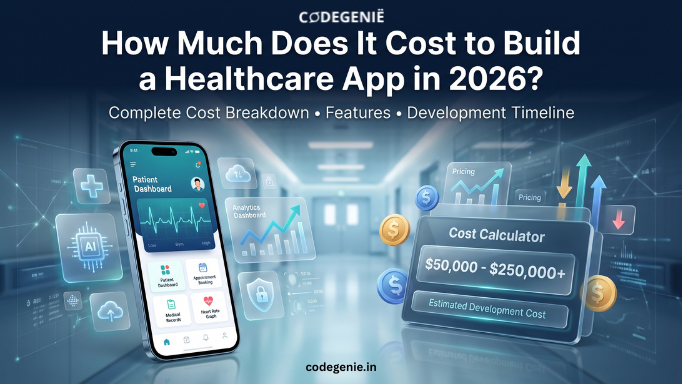
A basic healthcare app — think appointment booking, a symptom checker, or medication reminders — will usually land somewhere between $40,000 and $80,000. A mid-tier app with patient-doctor messaging, wearable integration, and a real backend typically runs $80,000 to $150,000. And if you're building something like a telemedicine platform with video calls, EHR integration, and AI features, you're looking at $150,000 to $300,000 or more.
Those are the honest ranges. Anyone giving you one flat number without asking what you're actually building is guessing.
Why Healthcare Apps Cost More Than Other Apps
Here's the thing, people don't expect going in — a healthcare app isn't really an app with some health features. It's a piece of software that has to handle other people's medical information responsibly, and that changes almost everything about how it gets built.
The moment your app touches anything resembling personal health data, HIPAA compliance enters the picture. And HIPAA isn't a checkbox you tick at the end. It shapes how you store data, how you log access to that data, how you encrypt it, and even how your team is allowed to work with it during development. Most estimates put the added cost of HIPAA compliance at somewhere between 15% and 30% on top of a standard build. If you're selling to European users too, add GDPR considerations on top of that.
It's tempting to think you can skip this and add compliance later. You really can't — or rather, you can, but it costs far more to retrofit security into an app than to build it in from day one. Teams that try to cut this corner almost always end up paying for it twice.
What Actually Drives the Cost Up or Down
The Type of App You're Building
A medication reminder app and a remote patient monitoring platform are both healthcare apps, but they have almost nothing in common in terms of engineering effort. Patient-facing apps — appointment scheduling, wellness tracking, symptom checkers — are the cheapest category because they're mostly about a clean interface and reliable notifications.
Telemedicine apps cost more because video infrastructure isn't trivial to get right, especially when you need it to be reliable on bad hospital Wi-Fi. Remote patient monitoring apps, which connect to wearables and devices to track vitals in real time, add another layer of cost because you're now dealing with hardware integrations and continuous data streams.
EHR Integration
If your app needs to talk to an Electronic Health Record system, budget for this separately and budget generously. EHR integration is one of the most unpredictable cost drivers in the entire project. A simple read-only data feed is manageable. A two-way integration with a system like Epic or eClinicalWorks, where data flows in both directions, is a different project entirely — and if you need to support more than one EHR vendor, the testing burden alone adds real time and money, since each vendor's certification process is independent.
A good rule here: only add EHR integrations your users will actually need on day one. It's easy to overscope this early.
Where Your Development Team Is Based
This is the single biggest lever on your total budget, and it's not subtle — there's roughly a 5x to 10x difference in hourly rates between the most expensive markets and the most affordable ones. Offshore teams, particularly in India, regularly deliver the same quality at 40-60% lower cost than US-based agencies.
The catch is that this only holds if the team actually has healthcare experience. A developer with no HIPAA background isn't a discount — they're a remediation project waiting to happen. Before hiring anyone offshore for a healthcare build, ask for references from completed healthcare projects, ask whether they'll sign a BAA as a standard part of the contract, and ask specifically about their experience with HIPAA implementation. If those answers come slowly or vaguely, that's your answer.
AI Features
AI is no longer a nice-to-have in healthcare apps — buyers increasingly expect some level of it, whether that's symptom triage, clinical documentation support, or basic diagnostic assistance. But AI in a healthcare context comes with its own compliance baggage, because now you have to think about how protected health information moves through an AI pipeline, not just through your database. This isn't something you bolt on casually. If AI is part of your roadmap, it needs to be part of your compliance planning from the start, not an afterthought six months in.
What People Forget to Budget For
Almost every founder underestimates ongoing costs. Once your app is live, expect to spend roughly 15-25% of your original development budget every year on maintenance — OS updates, cloud hosting (typically $500 to $3,000 a month depending on scale), security patches, and compliance re-audits. If your app integrates with an EHR, add extra time for monitoring, since upstream API changes on the EHR's side can quietly break your integration without warning.
None of this is meant to scare you off. It's meant to help you budget realistically so you're not blindsided six months after launch.
So What Should You Actually Do?
Start by figuring out your compliance obligations before you even think about features. That sounds backwards, but it isn't — your compliance requirements determine your architecture, and your architecture determines what features are even feasible within budget. Once that's settled, build an MVP. Don't try to launch with every feature you can imagine. Launch with the smallest version that solves the core problem, get it in front of real users, and let their feedback guide what you build next.
Healthcare is one of the few industries where moving fast and breaking things genuinely isn't an option. But moving deliberately, with the right team and the right priorities, still gets you to market faster than most people expect — and at a cost that actually matches what you set out to build.
Building a Healthcare App? Let's Talk
At CodeGenie, we've built HIPAA-compliant healthcare apps from the MVP stage through full enterprise platforms. We'll help you figure out exactly what your app needs — not what an agency wants to sell you — and give you a realistic cost estimate before you commit to anything.
Get a Free Consultation → (https://www.codegenie.in/contact)